The gap is visible in the data. Gallup's 2025 survey found that 44% of employees say their organization has integrated AI, but only 22% report a clear plan. Access is there. Support isn't.
This guide takes a people-first approach for CHROs, senior leaders, HR and L&D teams, and middle managers. You'll define the role, design the program, recruit and prepare champions, build a feedback rhythm, and measure whether adoption is useful and sustainable.
Key Takeaways
- Champions are trusted translators, coaches, and early-warning signals, not just enthusiastic tool users.
- Pick for credibility, judgment, and patience, and represent different functions and viewpoints.
- Give champions protected time, clear limits, training, and a leadership sponsor.
- Measure workflow change, trust, and quality, not just logins.
What Is an AI Champions Program, and What Does an AI Champion Do?
The AI champion role
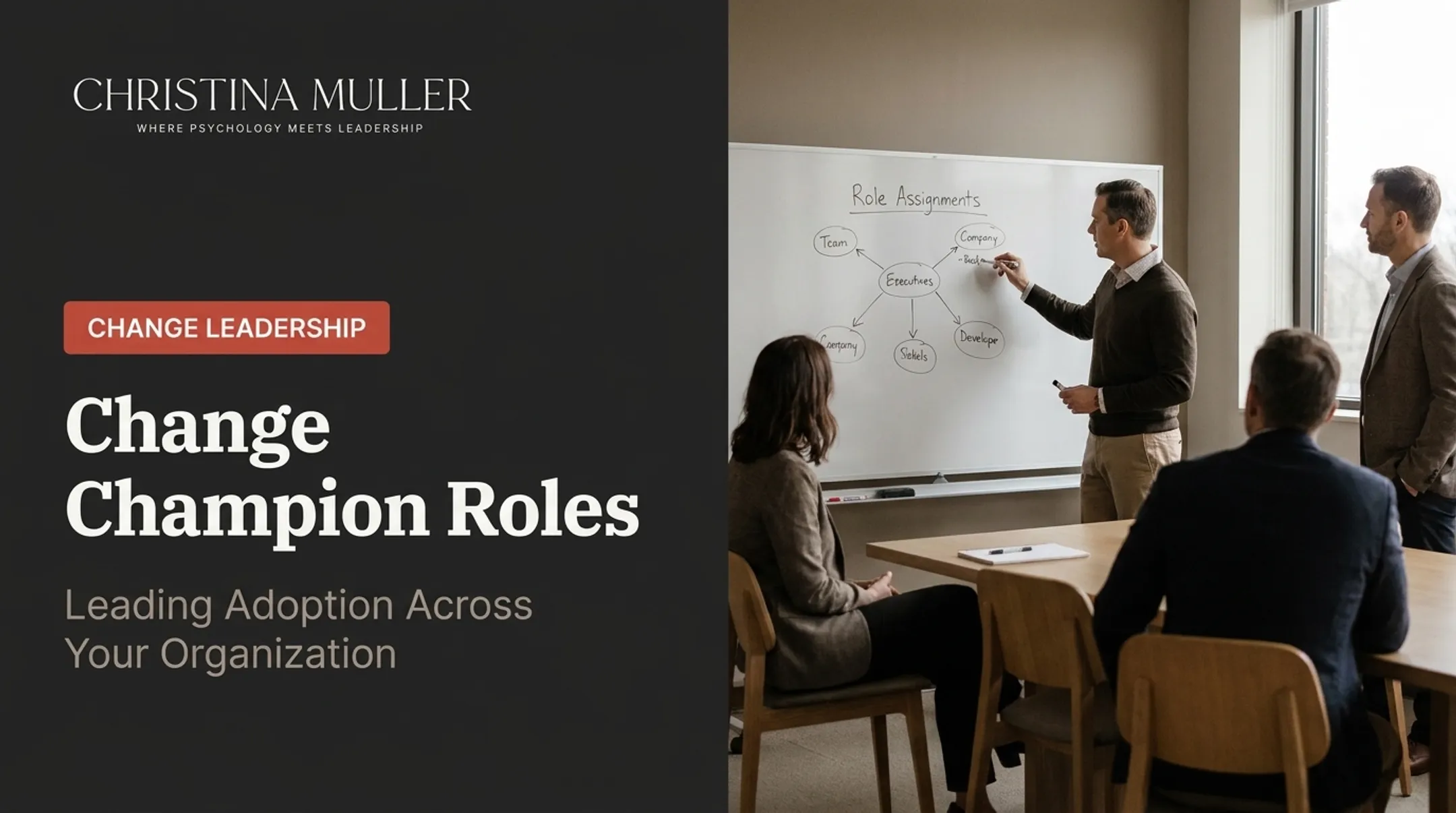
An AI champion is a trusted employee who helps colleagues understand, test, and responsibly use AI in real work. Champions also carry frontline feedback back to leaders.
An AI champions program is a structured peer network of these employees. It puts practical adoption support inside teams instead of leaving it only with IT, training, or a vendor.
The role still has limits. Microsoft's champion role guidance says champions complement IT, compliance, and training teams rather than replace them. A champion is not:
- An IT administrator or AI developer
- The compliance or security owner
- A corporate spokesperson
- The person who sets policy
Why a structured peer network works
A coordinated network makes AI tangible at the team level. Colleagues ask a peer "how would I use this on my invoices?" far more readily than they ask a vendor or an executive.
It also gives leaders an earlier read on confusion, resistance, workflow friction, and promising use cases. BDO's AI Ambassadors, for example, run hands-on peer workshops across practices and support change management.
Network composition matters. Research on 170 physicians found that inward-looking, homogeneous networks can impede participation, while diverse, cross-unit connections help. That study covered organizational restructuring, not AI, but the lesson transfers: don't build a club of early adopters.
Outcomes to aim for
- Clearer role expectations
- Greater employee confidence
- Better use of human judgment
- Stronger feedback loops
- Responsible adoption that doesn't leave middle managers carrying the change alone
Design the Program Before You Recruit
Set purpose, baseline, and ownership
Decide what the program should improve: workflow adoption, confidence, manager readiness, quality, or safe experimentation. Then name who owns decisions, funding, policy, and escalation.
Next, establish a baseline. Listen to employees and managers about current AI use, uncertainty, workload, and support gaps. A people-side diagnostic can help. The free COUNTED at work™ Score, a five-minute online assessment, measures leaders' clarity, ownership, and perceived support during AI adoption.
Choose a focused pilot with guardrails
Start small. OpenAI Academy's guidance suggests beginning with three to five credible people from teams with clear workflow opportunities. That is vendor guidance, not a proven benchmark, but the principle holds: you don't need full coverage on day one.
Pick low-risk workflows where people can see a practical benefit. Involve HR, legal, compliance, security, and operations early. Before champions promote anything, define:
- Approved tools and data boundaries
- Human-review expectations
- Prohibited uses
- Escalation routes
- Documentation requirements
The NIST AI Risk Management Framework similarly calls for clearly defined human oversight roles and documented feedback channels.

Write a charter
Document the essentials so the role is clear and supported:
- Responsibilities and decision rights
- Time expectations and term length
- Recognition and success measures
- Limits of the role
The charter is what makes this supported organizational work rather than unpaid extra labor.
Recruit and Prepare the Right AI Champions
Select for influence and judgment
Technical enthusiasm is the weakest selection criterion. Look for people who:
- Are already trusted by their peers
- Are curious about improving work
- Stay patient with colleagues who struggle
- Question poor AI outputs
- Communicate across different comfort levels
Recruit across departments, seniority levels, and perspectives. Include a respected skeptic or two. Their questions make the program more credible.
Define expectations and protect capacity
Give every champion a written role description covering peer support, demonstrations, feedback collection, documentation, and risk escalation. Then get explicit manager approval.
The University of Utah's new program, for instance, tells participants to expect about 3-5 hours per month and to talk with their supervisor first. Treat that as one institutional example, not a universal standard. The point is that the time is named and protected.
Build practical, continuous training
Cover AI fundamentals, approved tools, verification, privacy, security, bias, and when human expertise must stay in control. Then practice with role-specific scenarios.
Include role-play with skeptical or anxious colleagues. The stakes are real: Gallup's 2026 analysis found frequent AI users are more than twice as likely to fear job elimination within five years than infrequent users. Champions need to acknowledge that worry without dismissing it or overselling the benefits.

Equip middle managers
Managers decide whether champions get time and whether mistakes feel safe. Give them language for explaining changing responsibilities, setting realistic expectations, and recognizing contributions.
A targeted option is Christina Muller's Carrying the Rollout™ workshops, available in half-day and full-day formats. They help leaders sort out what they own, what to hand back, and who decides.
Build a champion community
Give champions a few durable supports:
- A private channel for questions and shared examples
- Peer-learning sessions and office hours
- Direct access to a leadership sponsor
- Recognition tied to performance conversations
- Rotation or succession, so the most helpful people don't carry the role forever
Create the Operating Rhythm That Drives Adoption
Start with real work
Skip the generic demo. Ask each champion to pick one recurring workflow where AI might reduce friction or improve preparation. Involve the people who do that work in defining the problem and what a good result looks like.
Set boundaries before testing:
- What AI may assist with
- What needs human review
- What data can't be entered
- How to verify outputs
Establish a repeatable cadence
Combine team demos, office hours, champion peer meetings, manager check-ins, and leadership reviews at a pace you can sustain. OpenAI's guidance describes monthly workflow sharing, occasional office hours, and quarterly reviews.
Make each touchpoint count by sharing:
- One practical example
- One lesson or limitation
- One employee question
- One action needed from leadership
Build a two-way feedback loop
Give champions a consistent way to capture:
- Questions and barriers
- Workload concerns
- Role ambiguity
- Policy confusion
Keep it structured so it doesn't become a complaint queue.
Then assign owners and response times. Employees need to see feedback lead to a decision, a clarification, or an honest explanation of why nothing has changed yet.

Keep a reusable knowledge library
For each approved workflow, record:
- Problem and tool
- Sample instructions
- Output checks
- Data restrictions
- Human owner
- Lessons learned
Review the library as tools and policies change. Delete outdated examples so no one spreads unsafe practices.
Protect trust and psychological safety
Be honest about what's changing and what isn't. Make clear that employee judgment still matters. Amy Edmondson's field study of 51 manufacturing teams linked team psychological safety to learning behavior, and the same applies here.
Never use champions to pressure colleagues, monitor individual experimentation, or imply that reluctance is a character flaw. Their job is to surface uncertainty and offer support.
Measure Impact, Learn, and Scale the Program
Balance activity and outcome measures
Attendance, questions, demos, and documented use cases show activity. They don't show whether work improved. Prosci's adoption framework looks at speed, utilization, and proficiency, including performance against established KPIs.
Track outcomes alongside activity:
- Approved AI used in meaningful workflows
- Confidence and clarity
- Quality and rework
- Employee experience
- Risk signals
Combine numbers with stories
Blend the numbers with qualitative signal from:
- Workflow observations and quality checks
- Manager feedback and pulse surveys
- Champion logs and support requests
Compare teams with strong support to those that are struggling. Don't conclude anything from tool usage or self-reported enthusiasm alone.
Review the pilot and decide next steps
Compare results with your baseline. Did the pilot improve the intended outcome without creating privacy, quality, workload, or trust problems?
Then decide, for each use case, whether to stop, redesign, deepen, or expand. Write down what you learned so you don't repeat failed experiments.

Scale through standards
Scale means repeatable infrastructure:
- Onboarding path and shared templates
- Manager guidance and governance checkpoints
- A succession plan for champions
Expand only when leadership can supply access, policy clarity, learning support, and response capacity.
Citi reports more than 2,000 colleagues across its AI Champions and AI Accelerator programs combined, with real-time feedback built in. That reflects deliberate infrastructure, not a one-off launch.
Give executives a decision-ready update
Summarize the decisions leadership needs next:
- What changed
- Where employees need clarity
- Which risks need a decision
- Which workflows are ready to expand
- What resources or policy changes come next
Champions can reveal and speed up change. Executives still have to remove barriers, decide, protect capacity, and keep people central to the rollout.
Frequently Asked Questions
What is an AI champion?
A trusted employee who helps colleagues apply AI to real work and promotes responsible use. They also bring feedback and risks to the right leaders.
What do AI champions do?
They coach peers, run practical demonstrations, document workflows, collect feedback, and escalate risks. They support colleagues at every level of AI confidence.
What is the AI Champions program?
It's a structured employee network backed by clear expectations, training, protected time, governance, and leadership access. Success is measured by meaningful adoption, not logins.
Is the AI challenge free?
An internal challenge or pilot can start with existing tools and staff time. Structured training, advisory support, diagnostics, and workshops may carry separate costs.
Are any AI programs free?
Yes. Microsoft's free champion program is one example, and peer programs run in-house cost mainly staff time. Others, like Google AI Essentials, charge after a trial. Weigh privacy, quality, governance, and support before choosing.